
How Much Does Epoxy Floor Coating Cost?
Epoxy floor prices vary so widely from person to person mostly because people are pricing different scopes of work. Below is a look at the pieces of a professional estimate, the way each one nudges the total, and the line items that belong in a thorough written proposal.

The Short Answer
For budgeting, professionally installed epoxy floor coatings commonly cost $6–$10 per square foot. At the $8 midpoint, an average two-car garage comes to something like $3,200–$4,000. The real number for your project rests on floor size, the prep your concrete requires and the right coating system for the space, and those details only firm up after an in-person evaluation.
What Affects the Cost?
Behind most gaps between epoxy proposals sit the same five factors.
01
Floor Size
Bigger floors consume extra material and extra labor. Some expenses, however, stay nearly flat regardless of size, like moving equipment to the site, setup and mobilization. A large floor absorbs those fixed costs into a smaller share of the total; a small one feels them more. Precise measuring gives the estimate solid footing.
02
Concrete Condition
Oil-saturated spots, leftover sealers, widespread cracks or a deteriorating surface all mean extra prep before coating can start. An intact, never-treated slab needs far less effort to reach the profile coatings require.
03
Surface Preparation
Grinding opens the slab and creates the texture a coating bonds to. The amount needed varies with the concrete: hard-troweled surfaces, damage and old coatings each widen the scope. When an estimate includes real preparation, it reflects what a high-performing floor truly costs.
04
Coating System
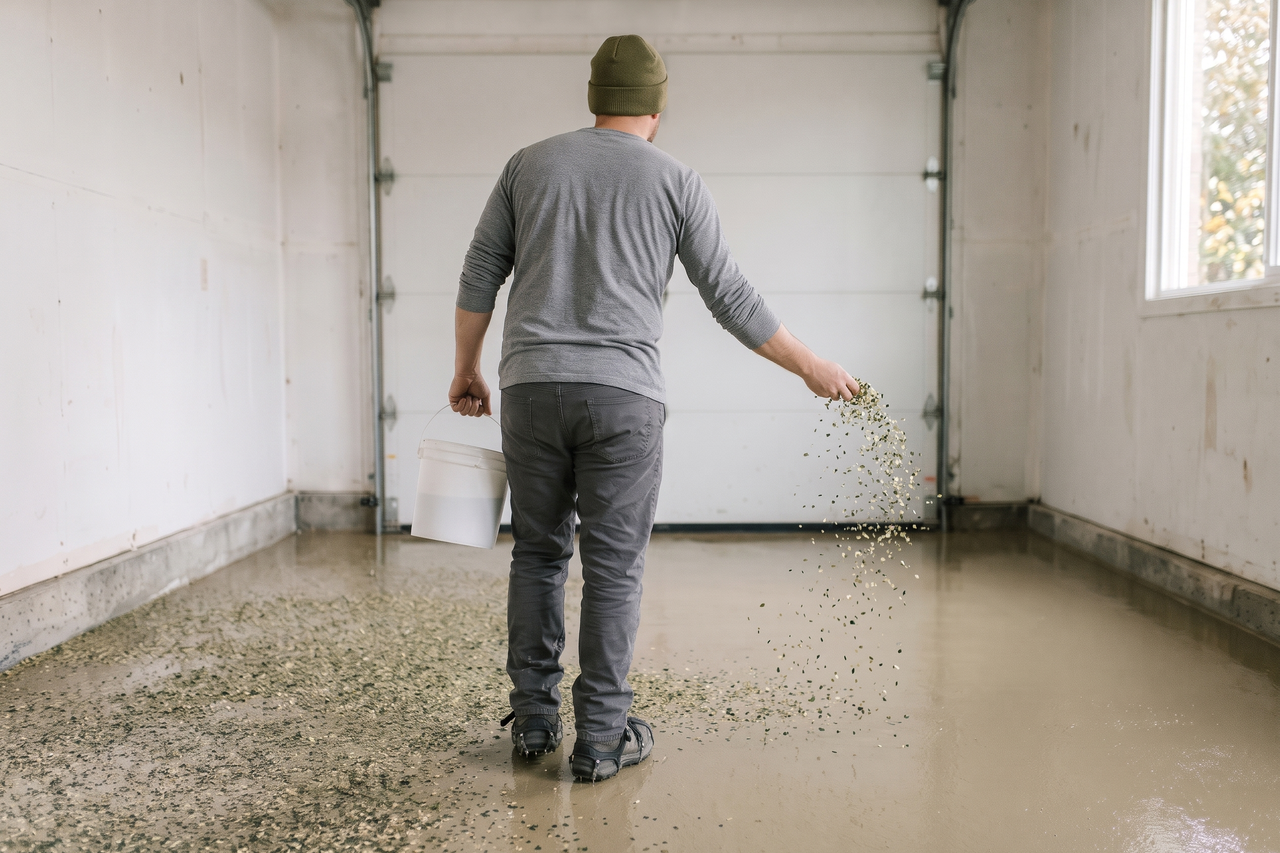
One-coat applications sit at the low end of material cost. Layered builds, where primer, decorative flake and a thick base coat sit under a urethane or polyaspartic topcoat, use a good deal more product. The correct system grows out of the slab’s condition and the space’s demands, not a stock package.
05
Decorative Finish
Solid color is the easiest decorative finish to apply and the lowest in cost. Flake systems need extra material and labor, giving a textured, multi-tone look. Metallic finishes need specialized technique and occupy the top tier of decorative pricing.
What Are You Really Paying For?
Our guide to how a coating project unfolds walks through every stage of a professional installation and explains what each one accomplishes.
What the estimate buys is the full project: labor to prep and coat, grinding machines and the consumables they eat, commercial-grade products, and the judgment needed to pick a suitable system for this exact floor. Material is only one slice of the price.
If one quote sits far below the rest, ask a simple question: what is not included? Less grinding, a thinner build or skipped crack repair mean a smaller job, not the same job at a discount. Lay the proposals next to each other and compare them line by line to learn what each really contains.
Trim the prep, coats or repairs and the price falls because the project got smaller, and the floor usually shows that difference as it wears.
How Much Does a Garage Floor Cost?
Here the $8 planning number is applied to four familiar garage sizes for rough budgeting.
| Garage | Floor Area | Planning Figure at $8/sq ft |
|---|---|---|
| Garage for one car | 250 sq ft | $2,000 |
| Garage for two cars (typical) | 400 sq ft | $3,200 |
| Garage for two cars (oversized) | 500 sq ft | $4,000 |
| Garage for three cars | 750 sq ft | $6,000 |
How the table works: each row is simply area times $8, the planning rate chosen from inside the $6–$10 range that professional installations commonly fall in. These numbers are for budgeting, not quotes. Real pricing depends on your concrete’s condition, its preparation needs and the system chosen, and it cannot be set until the floor has been seen in person.
Is It Worth the Cost?
A garage floor lives a rough life: a car pulling in and backing out, oil weeping from an engine, a wrench clattering down, a mower hauled across concrete never designed to stay looking good. Bare concrete takes every hit.
Unsealed concrete behaves like a sponge. Spills penetrate and leave marks, discoloration spreads with use, and mechanical wear grinds the surface down. Coat a slab that never got a proper profile and the bond may prove unreliable; if it lifts or peels, the owner pays for the floor all over again.
A coating selected for the real conditions of the room outperforms bare concrete by a wide margin at holding spills up top, ready for a rag or mop. That counts most in garages, shops and utility spaces where looks and easy cleanup matter.
What Should Be Included in Your Quote?
A good proposal accounts for the whole project, not just the product going down. When a written proposal reaches you, look for each of the following:
- Slab evaluation — moisture tests and a hands-on inspection before any work gets planned
- Profiling — shot blasting or diamond grinding that roughens the concrete enough for a coating to grip
- Crack and spall repair finished while the concrete is still bare
- Primer choice based on moisture results and how porous the slab is
- Base coat and broadcast — pigmented color coat with any decorative flake, applied per the selected system
- Topcoat sized to the traffic and conditions ahead of the floor
- Cleanup — hauling away grinding dust, prep debris and waste
- Cure guidance explaining which loads are acceptable at each point once the final coat is down
Spot a gap in a written proposal? Before signing, ask the contractor how that item gets handled.
Frequently Asked Questions
Q: What makes epoxy estimates differ so much from contractor to contractor?
Scope explains most of it. Thinner preparation, fewer coats or a missing crack-repair line add up to less work, and the cheaper number reflects that, not greater efficiency. Comparing proposals side by side, item by item, reveals what each truly covers.
Q: Is per-foot pricing usually lower on a large floor?
Often, yes. Mobilization costs like hauling equipment and site setup barely change with floor size, so a big slab spreads them across more square footage. On a small floor, they claim a bigger part of the total.
Q: Is the $6–$10 range enough for early budgeting?
As a first pass, yes. Apply the $8 midpoint to the garage chart above for a ballpark based purely on size. What the range cannot capture is the state of your concrete, the prep it calls for or the right system, which is why a meaningful figure requires someone to evaluate the floor in person.
Q: Can the shape the concrete is in really change the price?
Sometimes by a lot. Heavy repair work, stripping an old coating or extensive patching adds labor and material to the prep stage. Where a slab is in rough shape, prep may take up a sizable portion of the estimate.
Q: Which expenses usually sit outside a flooring proposal?
Owners usually handle clearing out vehicles, equipment and stored belongings before the work. A standard flooring proposal generally leaves out structural slab problems, drainage corrections and any repair work beyond the coating itself.
Q: What might a higher estimate be telling me?
Frequently, a bigger scope: added coats, premium materials or a system designed to take a harder beating. The number alone proves nothing; find out what it covers and why the system on paper makes sense for your floor. A clear, specific answer is a good sign the recommendation was well considered.
Ready to Get a Real Number for Your Floor?
Serving Chillicothe, MO and surrounding areas. Describe the slab, its condition and its use to request a customized quote shaped by what the floor actually needs.