
Epoxy Floor Repair
Coating failures come in several varieties. A crack slicing the finish, a section curling off the slab, a lane of traffic scuffed to gray concrete: each traces to its own root cause, so a good repair starts by naming the problem correctly. A small, contained flaw on a floor that is otherwise sound may need only spot work, whereas bond loss across the slab may call for starting fresh. Distinguishing between the two means inspecting the coating and the concrete under it up close.

The Short Answer
Damage tends to leave fingerprints. Chips and cracks in the coating typically trace back to something hitting the surface or to concrete shifting underneath. Peeling and lifting point to a broken bond between coating and slab. Dullness and staining creep in through traffic and chemical contact. Different causes mean different fixes, so the right course begins by evaluating which part failed, how far the trouble has spread and what condition the concrete beneath is in.
Common Problems With Epoxy Floors
Typical evaluation findings, sorted by the main kinds of coating damage.
01
Cracks & Chips
Most damage falls into two camps. Chips, gouges and scrapes arrive from above, the work of a dropped wrench, a rolling cart or some heavy object meeting the coating. Cracks in the finish more often originate below, as settling, changing loads or thermal movement in the concrete telegraph upward into the coating. If the damage is contained and the coating surrounding it is still tightly bonded, spot repairs could work. That judgment belongs to your installer, made after reviewing both the damage and what probably caused it.
02
Peeling & Delamination
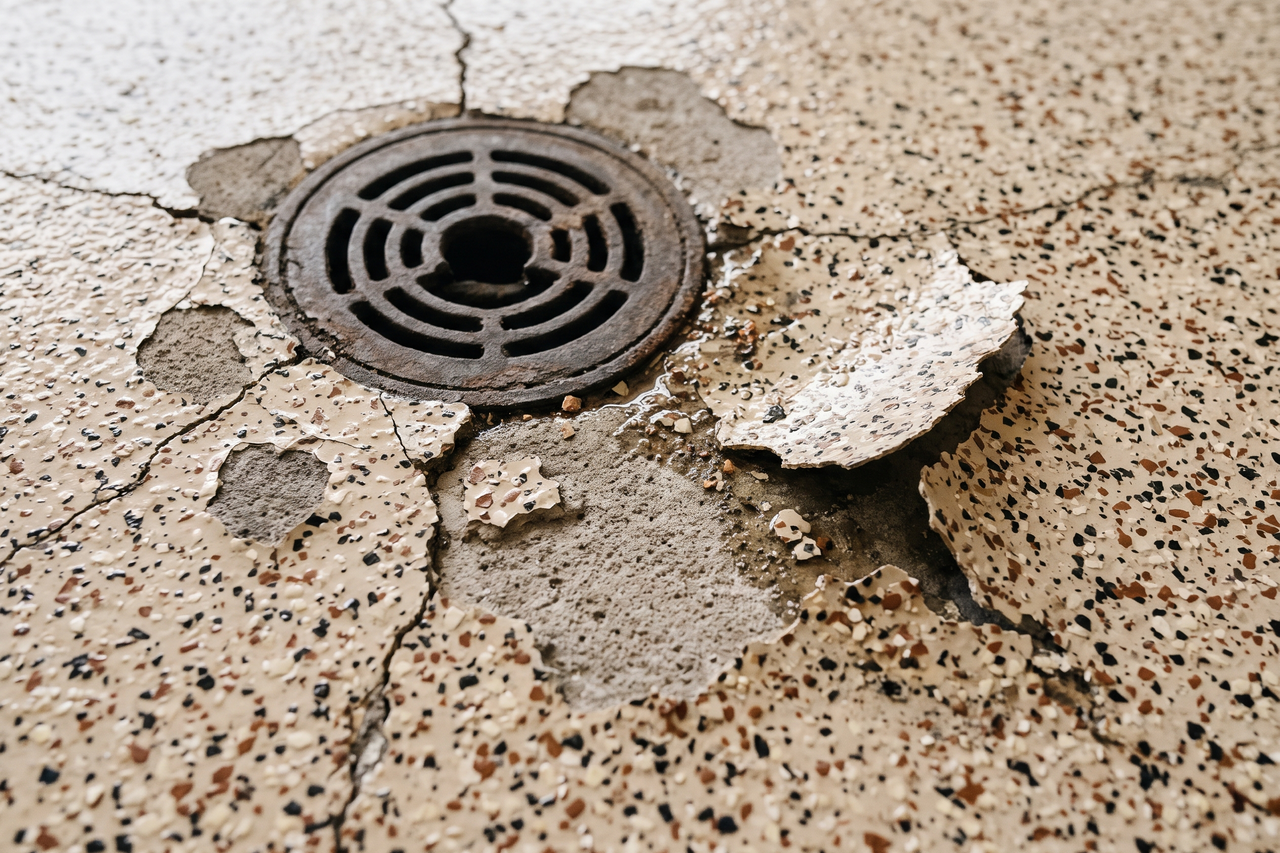
Peeling rarely stays polite. A coating that releases in one spot usually keeps releasing outward. The message is a broken bond with the concrete, and the reason behind that break is the core of a repair that lasts. Very often the story starts with the original installation: moisture in the slab nobody tested, concrete that never received the profile the product needed, or a previous layer that stopped the new coating from bonding to sound concrete. Finding the cause is what makes a durable repair achievable.
03
Stains & Surface Wear
Scuff marks, a faded sheen and discoloration from spills and daily use are not the same as bond failure. The floor may look tired even though the coating beneath the surface is still holding tight to the concrete. Here, refreshing the surface with a topcoat on the sound base layers might do the trick. Your installer checks adhesion and reviews the coating’s overall condition before pointing in that direction.
How Do Professionals Repair Peeling or Damaged Epoxy Floors?
Repairs begin with a close inspection of the existing coating. The aim is to learn which sections are still firmly attached, what set off the failure and what condition the damaged zones of concrete are in.
Anything loose or lifting has to come out; new material does not get layered over it. If a section rings hollow when tapped or peels with a little prying, the bond is already gone, and burying it under fresh product only relocates the failure. With the failed coating removed, the exposed slab is cleaned and roughened by profiling, so the repair material or new coating has solid footing to bite.
If separation turns out to be widespread, the plan may change from spot fixes to recoating everything, a decision held back until the damage has been fully mapped.
A repair’s staying power depends heavily on the preparation of the exposed concrete once the old coating is stripped. Our page on getting concrete ready for a coating describes that work.
Can an Epoxy Floor Be Repaired, or Does It Need to Be Replaced?
Sometimes a floor is repaired, sometimes it is replaced, and both can be the correct answer. Two questions settle it: what share of the coating still grips the slab, and why the rest let go.
Tearing out everything is not the opening move. When the damage is confined to one defined area, say a single lifted section, a handful of impact chips or a crack that has quit moving, repairing just those spots while the healthy coating stays can be a practical, budget-friendly way to add service life.
Stripping and recoating becomes the stronger choice if bond loss spans most of the slab, if whatever caused the original failure is still in play, or if the deterioration is too far along for spot repairs to do much good.
Eyeballing has limits. Tapping, adhesion testing and examining the concrete under problem areas reveal much more than a casual stroll across the surface. If a full new floor ends up being the better option, our explanation of how a new epoxy floor is installed covers each stage.
How Much Does Epoxy Floor Repair Cost?
Any repair price worth having comes after someone has seen the floor. The word repair covers a lot of ground, from filling a single hairline crack in an otherwise healthy coating to stripping and recoating a slab whose adhesion has failed nearly everywhere. Scope turns on the type and amount of damage, the quantity of coating to remove, how the underlying concrete is holding up and the preparation required.
Numbers quoted sight unseen are of little real value.
What Causes Epoxy Floors to Fail, and How Can You Prevent It?
Planning a fresh floor or staring at one that has started to fail? Either way, it pays to understand why coatings give out. A short list of culprits accounts for much of the early failure seen in the field.
Improper Concrete Preparation
Trace a failing coating back far enough and preparation frequently turns out to be the weak link: a surface profile that never got deep enough, contaminants left on the slab, or an old layer acting as a barrier between new product and sound concrete. Any of the three can starve the coating of mechanical grip. A floor in that state may look fine at first, then slowly loosen its hold as traffic grinds on it.
Any coating project should treat preparation as its own stage. Our breakdown of concrete preparation steps covers what thorough work looks like.
Excess Moisture
Slab moisture is simple to overlook while a floor is going in and stubborn to fix once it is coated. Vapor collecting beneath the coating shoves upward on the bond, and blisters, bubbles or creeping separation can turn up long after the floor looks finished. A moisture test before coating lets product decisions follow the slab’s true behavior.
Heavy Impacts and Chemical Exposure
Every product has a ceiling. Heavy objects falling, chemicals beyond what the product was designed to resist and nonstop grit under busy foot traffic can each wear on a floor that was put down correctly. Picking a product that suits the actual demands of the space is part of getting the original choice right.
Improper Installation or Curing
Excellent preparation still cannot rescue a floor from application errors. A wrong ratio in the mix, coating outside the product’s temperature or humidity limits, hurrying between coats or a poor curing environment can individually trigger early failure.
Before work begins, your installer should cover the curing requirements plus the site conditions the product depends on as it goes down and as it cures. When application turns out to be the culprit, redoing it under proper conditions is often sensible. To see how a well-run job unfolds, read our epoxy floor installation overview.
Can Garage, Basement, and Commercial Epoxy Floors Be Repaired?
Setting matters. The type and scale of damage, and how hard the space works, shape which repair approach is reasonable.
Garage Floor Repair
Few floors take more punishment than a garage: vehicle weight, swings in temperature, dripping fluids and chemicals, plus the odd dropped tool or bumped mower deck. Inspections commonly find chipping from impacts, stable cracks and isolated pockets of separation. Where those problems stay limited and the coating around them holds firm, repairing only the damaged spots may do the job. When chemical attack or widespread bond loss covers a large share of the floor, stripping everything and recoating tends to be the smarter call. Our page on garage floor coating systems explains what a well-built garage floor typically includes.
Will part of the garage remain usable while the project is underway? Honestly, each project and contractor handles that differently; flag it as the estimate gets reviewed.
Basement Floor Repair
Below grade, moisture is behind coating failures more often than almost anywhere else, so a successful repair must deal with it. Leave the original moisture problem untouched and a new coating laid over it is likely to repeat the failure. Your installer checks the coating along with the slab’s moisture readings ahead of recommending a repair. Our basement floor coatings page explains what sets basement projects apart.
Commercial Epoxy Floor Repair
For businesses, a deteriorating floor is not only about looks. Once damage affects safe footing, sanitation or normal operations, it becomes a real operational concern. Localized damage surrounded by sound coating can often be handled with targeted repair. Widespread adhesion loss usually means a larger scope.
Keeping the facility operating through the work is possible on some jobs, depending on the project and the contractor, so put it on the agenda for the estimate discussion. Our commercial epoxy flooring overview describes the typical makeup of bigger commercial coating jobs.
Frequently Asked Questions About Epoxy Floor Repair
Can a hardware-store patch kit fix peeling epoxy?
A kit can cover the symptom, but without knowing why the coating let go, the fix is unlikely to last. Untested slab moisture, thin profiling on the first job or an unsuitable product will still be there under the patch, and the new layer tends to go the way of the old one. Addressing the root cause is what gives any repair a fair shot.
Spot repair or complete replacement: how is that decided?
Mostly, the extent of bond loss. Tapping and adhesion tests sort the firmly attached areas from the ones that have let go. One contained failure ringed by sound coating is often a fine candidate for spot work, while bond loss over most of the slab generally points toward stripping and recoating as the more dependable path.
What shapes the schedule for a repair?
Three things weigh in: the area needing work, the concrete’s preparation needs and the coating chosen. Before any work starts, your installer lays out the timeline, including the point at which walking on the floor is fine and what follows.
Will the patched area blend with the rest of the floor?
Three factors drive it: what product went down originally, the age and wear of the coating nearby, and the size of the repaired section. Your installer can give a realistic sense of how the repair will look before any work starts. When an even appearance from wall to wall matters most, a full-surface recoat generally produces the most consistent finish.
What makes an epoxy coating peel or deteriorate?
Slab moisture tops the list of frequent causes, but it has company: inadequate surface preparation on the original job, a product wrong for the substrate, mistakes in the mixing bucket or during application, and a poor curing environment that left the coating short of full hardness. The location and look of the damage help a flooring professional pin down the likeliest cause.
Could a worn but well-bonded floor take a new topcoat?
Sometimes it can. Should testing confirm a firm bond underneath and wear limited to the surface, a fresh topcoat applied over the prepared base may be a good fit. How well that suits your floor depends on the system selected, the coating’s current condition and how demanding the space is, which an evaluation confirms.
Ready to Evaluate Your Floor in Chillicothe, MO?
Is your epoxy floor showing cracks, peeling or worn-through patches? Tell us what you are seeing and about what share of the floor it covers, and request a customized repair estimate.